
5 Beginner Questions High Performing Coaches and Consultants Ask About AI
Plus Simple and Practical Answers

If you’ve been cautious about AI so far, that probably comes from caring about the quality of your work, not from being behind.
For coaches and consultants, that caution makes sense: presence, judgment, and trust are not details around the work; they are part of the work itself.
So the useful question is not “How do I use more AI?”
It is “Where would this actually help without getting in the way?”
Below are five common questions, a practical answer to each one, and the reasoning behind it.
1. “I feel overwhelmed. What would actually help me get started?”
Start with one use case, not a whole system.
For many coaches, the easiest place to begin is after a session, when there are messy notes, half-formed thoughts, and useful things that could easily get lost before the next conversation.
Try this:
Write your normal notes after a session.
Paste them into your AI tool.
Add this prompt:
Organize this into:
- key themes
- anything I might be missing
- 2–3 strong follow-up questions
Why this makes sense: Brief, structured session notes are widely recommended because they help with continuity, pattern recognition, and preparation for the next conversation. AI is not doing the reflection for you here; it is helping you structure it faster so you can see what matters more clearly.
A useful question after trying this once is: did it help you notice something real, or did it just reorganize what you already knew?
2. “I don’t want AI to make my work feel generic. How do I use it without losing my voice?”
If the first thing asked of AI is “write the finished post,” the result often feels flat or interchangeable. If it is used earlier, while thoughts are still forming, it can help sharpen what is already there instead of flattening it.
Try this instead of asking for a finished draft:
I’m thinking about burnout in my client work.
Here’s what I believe so far: [paste your thoughts]

Challenge this.
Show me what I might be missing.
What feels too obvious here?
What would make this more specific and useful?
Why this makes sense: Current work on AI in reflective practice treats it as a support for questioning, reframing, and pattern spotting rather than as a substitute for professional judgment. That matters for coaches because the value is not just the words on the page; it is the thinking behind them.
If this makes your thinking clearer while leaving the final words fully yours, that is already a meaningful win.
3. “What is the smallest AI win I could get that would actually matter?”
The post-session notes workflow above is probably the best small win.
It is easy to test, low risk, and tied to something that already happens every week. It also helps in a part of the workflow where even a small amount of extra clarity can carry over into the next session.
What you get from it:
clearer themes
possible blind spots
stronger follow-up questions
less mental clutter between sessions
Why this makes sense: The most successful uses of AI in professional settings are often narrow and specific rather than broad and transformational. A small, repeatable use case makes it easier to judge whether the tool is genuinely useful in practice, instead of turning AI into one more abstract thing to think about.
4. “Where in my workflow does AI actually help—and where should I keep it out?”
A simple rule works well here: use AI around the session, not during it.
The live coaching conversation depends on presence, trust, timing, and attention. Those are not side details; they are central to what makes coaching effective.
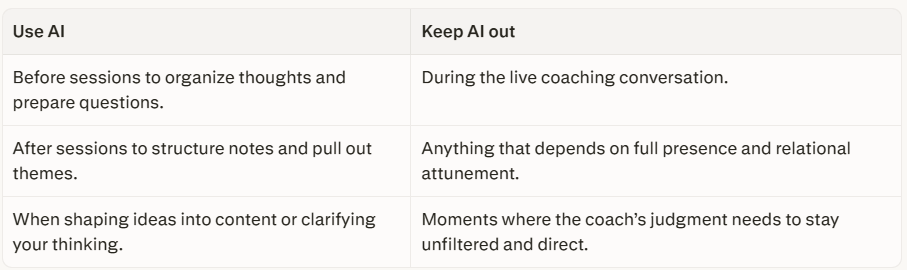
Why this makes sense: Research comparing AI and human coaching keeps coming back to the same point: human connection, empathy, and trust matter, especially in complex or emotionally nuanced work. That makes AI more useful as support before and after the session than as something sitting inside the heart of the interaction.
5. “Do I really need to rush into AI, or is there time to do this thoughtfully?”
There is no need to rush, but there is value in getting concrete.
Waiting until everything feels clear usually leads to endless observation and no experience. A better approach is to try one small thing in a low-stakes way and judge it by whether it actually helps your work.
A practical starting point for this week:
Set aside 15 minutes.
Use the post-session notes prompt once.
Notice whether it helps you think more clearly.
Keep it only if it proves useful.
Why this makes sense: Research on professional learning and reflective practice suggests that familiarity grows through small, repeated experiments inside real work rather than through large-scale adoption efforts. That kind of gradual use is also more aligned with how coaches protect quality: test, observe, adjust, and keep what works.
And if you try it and decide AI should stay at the edges of your work for now, that is a valid outcome too.
The goal is not to become “good at AI.”
The goal is to make one part of the work a little clearer, lighter, or more useful without losing the parts that need to stay fully human.
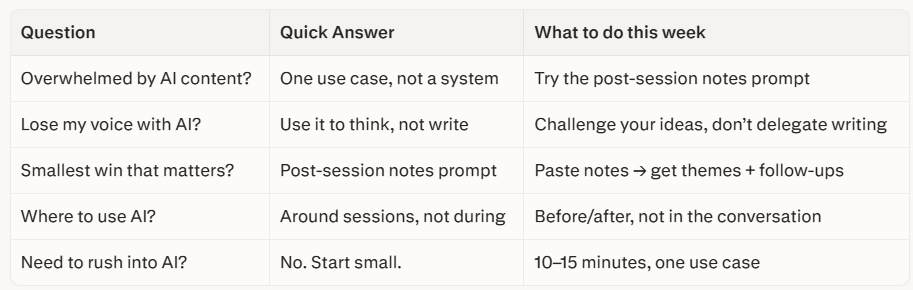
A Reference Table
We run a Skool community with weekly LIVE WORK WITH AI Sessions
JOIN US here: https://www.skool.com/action-heroes-2399
DID YOU LIKE THAT ARTICLE? Please show your appreciation with a like, share or comment